
Live today
Daily Challenge: the viral hook
Every day, all players worldwide face the same solo puzzle: a deterministic number-calling sequence seeded from that day’s date (so everyone gets an identical challenge, and the sequence is never exposed ahead of time;GET /daily/today returns only the challenge number and date, not the call order). You submit a board arrangement, the server simulates it against that day’s sequence and stops the moment 5 lines are complete, then returns your score, how many calls it took, and a shareable result card, generated in both Indonesian and English, e.g. "TheBingoFi #1 - 5 lines in 18 calls" with an emoji grid of your board. Scores are automatically submitted to that day’s leaderboard.
GET /daily/leaderboard returns the top 50 scores for a given date (one entry per nickname, best score only).
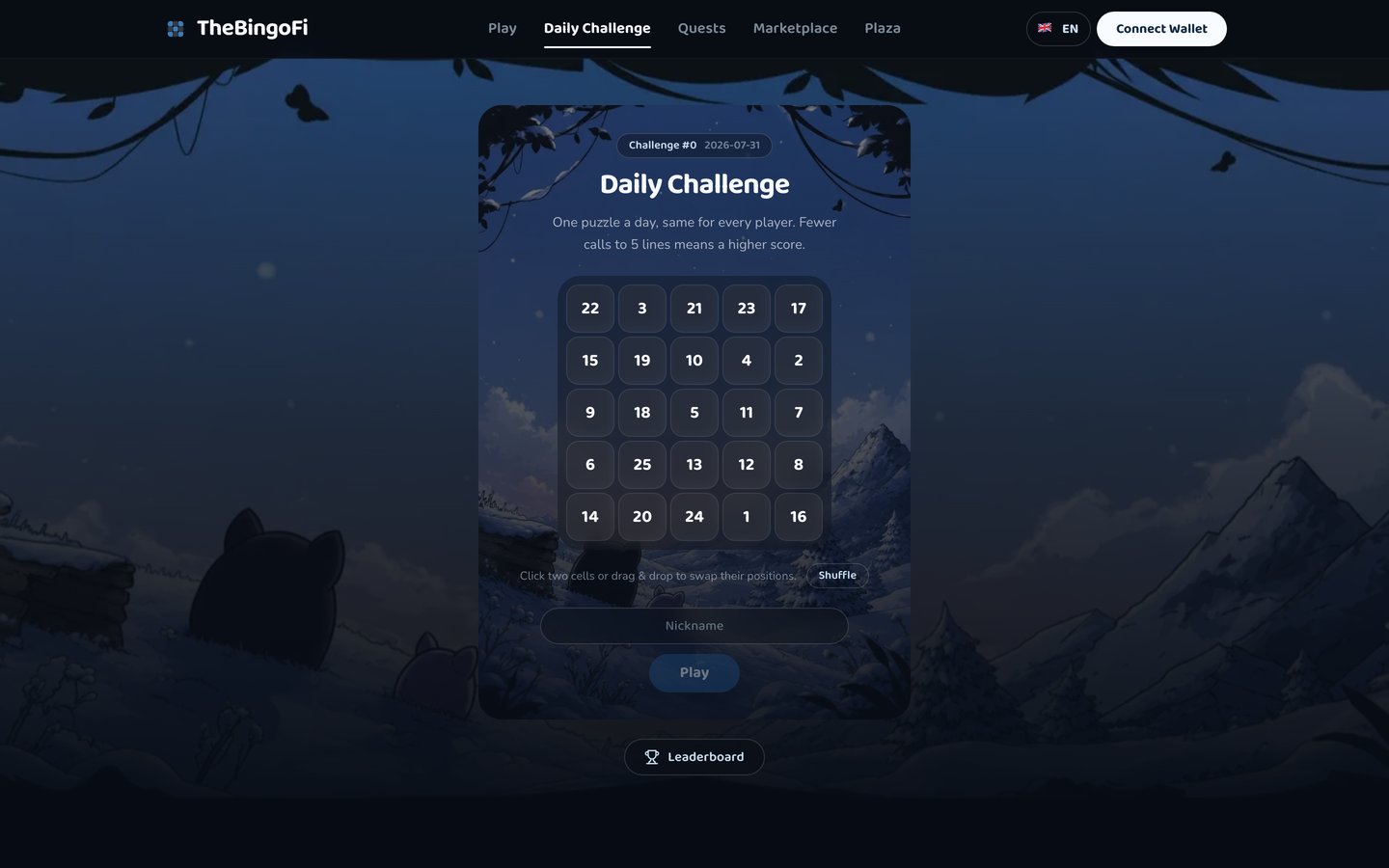
The Daily Challenge screen: today's puzzle, your score, and the shareable result card.
Quests, including the VS Bot ladder
GET /quests returns the live quest catalog. It includes standard quests (win a match, use a specific skill, complete a diagonal line, etc.) and 5 seasonal bot-ladder quests, “Beat Bot Lv1/3/5/7/10”, each completing automatically the moment you beat a bot at that level or higher (beating Lv5 completes the Lv1, Lv3, and Lv5 milestones in one match). quest:completed is pushed to a player’s own socket the instant a quest finishes; GET /quests/progress/:accountId returns the same progress data over HTTP.
Plaza: global chat and showcase
A global chat room (not scoped to any match room) where anyone connected, guest or wallet-linked, can post. Messages can optionally attach askillId the sender wants to show off (rendered client-side as a skill card, not plain text): this is the “promote/show off your collection” mechanic from the original design. Server-side rules: nickname 1-24 characters, message text 1-280 characters, a rate limit of one message per 2 seconds per socket, and a 100-message rolling history buffer.
skillId attached to a Plaza message is not verified against actual on-chain ownership today; it’s a display hint only. Ownership verification for this is planned alongside peer-to-peer marketplace features (see Roadmap & Status).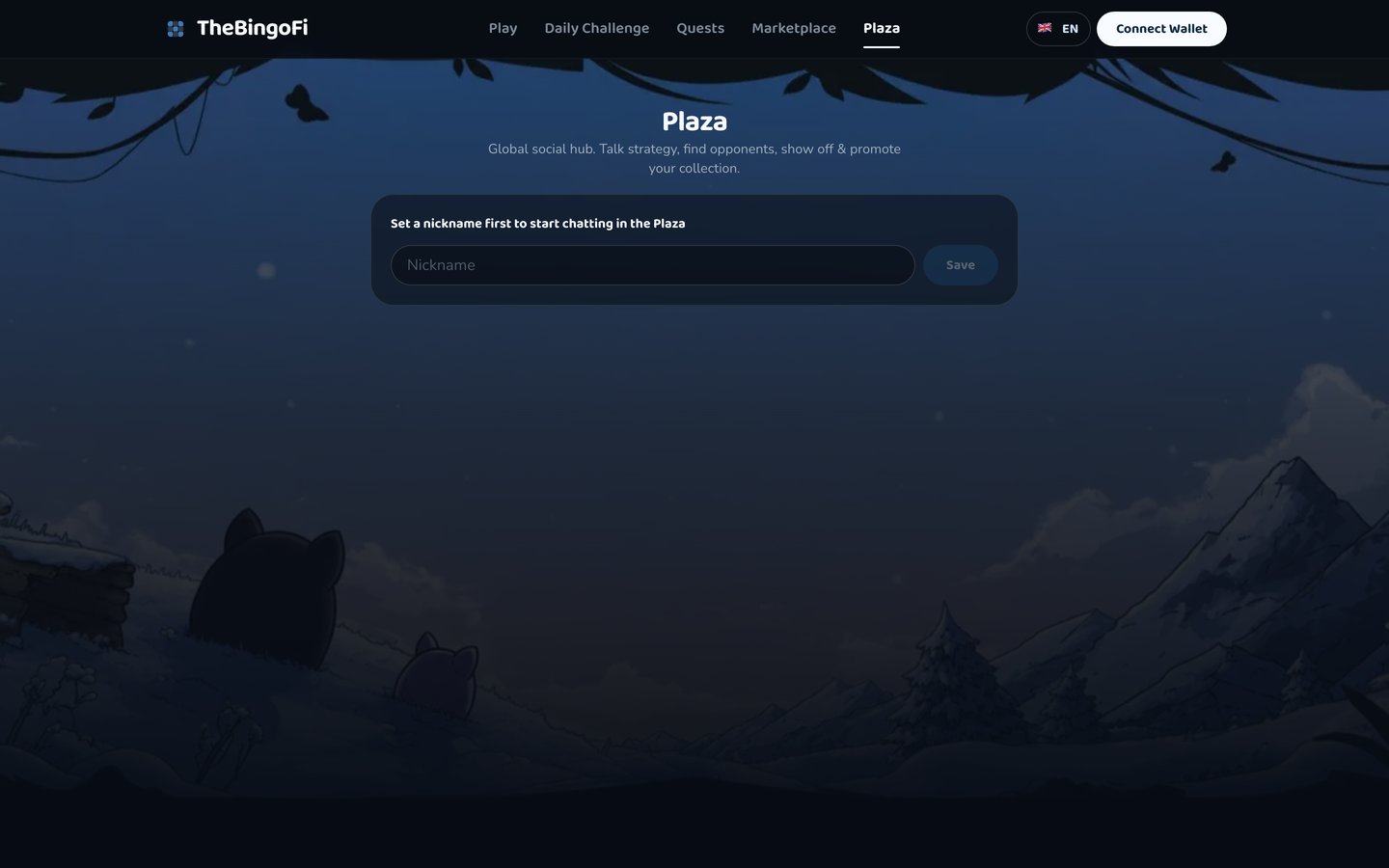
Plaza: the global chat and collection-showcase room.
Public shareable profiles
/profile/<address> shows a player’s on-chain skill/skin collection (grouped by rarity tier) plus copy-link/X/Telegram share buttons, meant to work as a player’s shareable “business card.”
Design ideas: not yet live
The following are part of the original social-layer design (CONCEPT.md §7) but are not implemented in the live server today:
Friends & referral
Friend graph, invite links, and referral quests.
Club/Guild
Club membership, club quests, and club leaderboards.
Spectator mode
Watching a friend’s or tournament match live.
In-match emotes
Preset quick-chat/emotes during a match.
Weekend/monthly events
Special win-condition modifiers, open tournament brackets, community goals.
Season Pass
A free cosmetic progression track (with an optional cosmetic-only premium track).
Broader leaderboards
Global / weekly / friends-only / club leaderboards. Only the Daily Challenge leaderboard exists today.
Peer-to-peer marketplace
User-to-user escrowed secondary listings, distinct from the primary sale covered in Economy & Business Model.
Metrics this loop targets
The social features above are each aimed at a specific KPI the project tracks for its accelerator evaluation, not at engagement for its own sake:- DAU and D1/D7/D30 retention: driven primarily by the Daily Challenge and quest reset cadence.
- K-factor: driven by the Daily Challenge share card and shareable public profile.
- Matches per user per day.
- Guest to wallet-linked conversion rate.
The acquisition loop behind K-factor
Each loop through this cycle is one shot at K-factor greater than zero: an existing guest’s result card is the only input, and a new guest landing on the app is the output. Nothing in the loop requires a wallet, so the acquisition funnel is not gated behind web3 friction.These are the metrics the product is instrumented and designed to move. This documentation does not claim any specific measured value for them, since no user/traffic figures are part of the project’s source-of-truth documents.