
Match flow at a glance
The board
Every player plays on their own 5×5 board containing the numbers 1-25. Boards are per-player and private: an opponent’s board layout is never shown to you, before or during the match.Draft phase
Before a match starts, every player arranges their own board during a draft phase: you place the numbers 1-25 into your 5×5 grid however you like (25 unique numbers, no duplicates). This is the first strategic decision of the match: your placement determines which lines are close to each other. The match only moves fromdraft to playing once every player has submitted a valid board.
Turn-based calling
Numbers are not drawn by a random caller. Instead, players take turns calling a number themselves. Whichever number is called gets marked on every board in the match at once (subject to the Ghost Call skill exception, see Skill System). This is what separates TheBingoFi from classic bingo: on your turn, you have to weigh which number helps your own board against which number you should avoid calling because it helps an opponent close a line.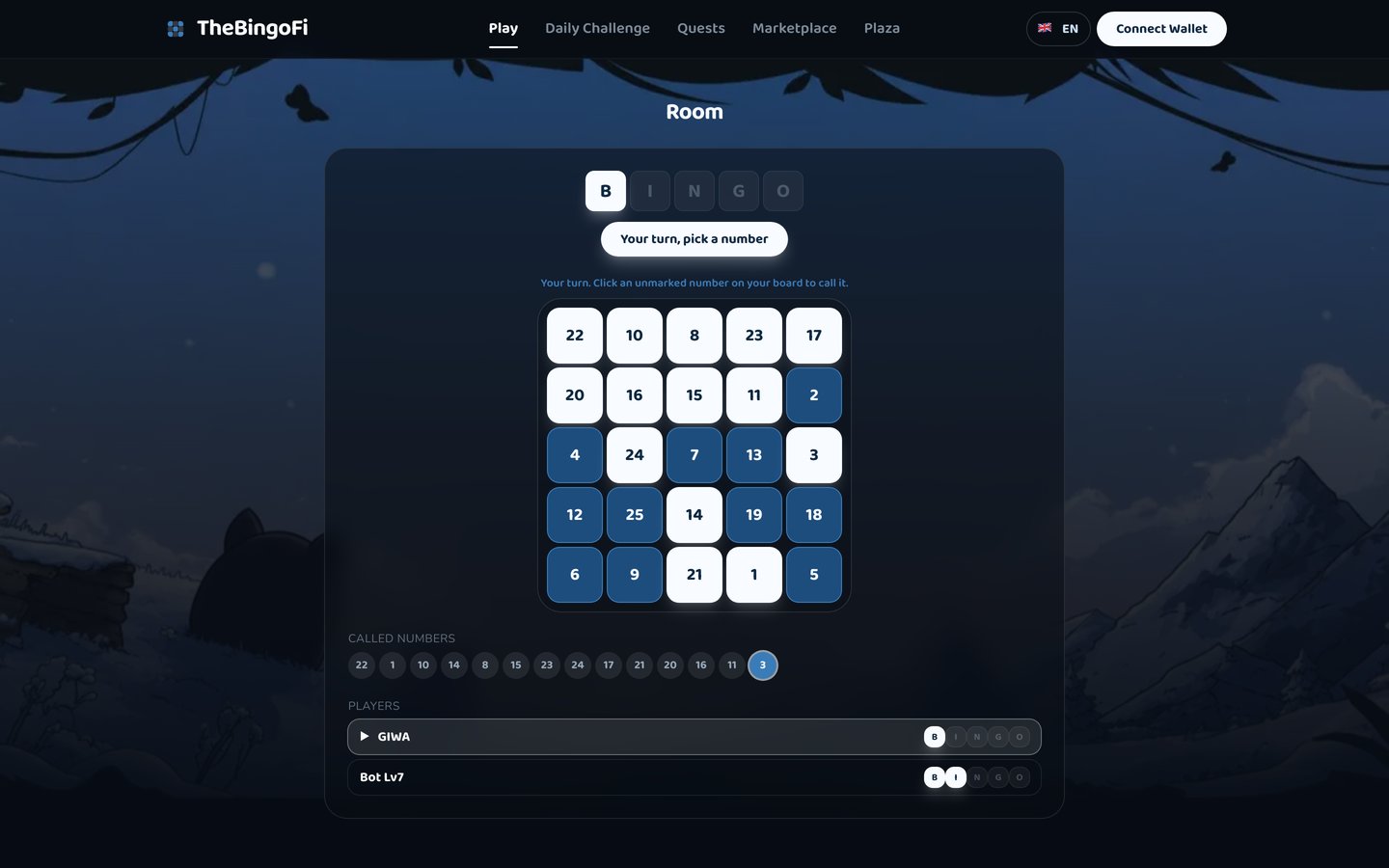
A live match: your own board, the call history, and the opponents' progress, with no visibility into their board layout.
Winning: 5 lines, B-I-N-G-O
A line is 5 marked numbers in a row: horizontal, vertical, or diagonal. The winner is the first player to complete 5 lines. Each completed line lights up one letter of B-I-N-G-O in order (1 line = B, 2 lines = B-I, … 5 lines = B-I-N-G-O), so the win condition is visually legible as it happens.Players per room
A room supports 2 to 5 players, set by whoever creates the room (target player count is configurable in that 2-5 range; a Quick Match room targets a specific size the same way).Match modes
- Casual
- Standard
No skills at all. This is the default mode and the mode used by Quick Match. Fully accessible to guest players with no wallet.
The original game design (see
CONCEPT.md) also describes a Ranked mode (loadout + skill-tier matchmaking) alongside Casual and Standard. Ranked is not implemented in the live server today: only Casual and Standard modes exist in the current room API.Getting into a match without waiting
TheBingoFi offers four ways to start playing, all designed so a player is never stuck waiting in an empty lobby:Quick Match (VS Player)
Quick Match (VS Player)
Pick a target player count (2-5) and the server either joins you to a matching public quick-match room or creates a new one. These rooms are always Casual (no skill loadout) and auto-start the draft phase the instant the room fills, with no host action required.
Room Browser
Room Browser
Browse a live list of open public rooms (host nickname, players filled/target, mode) and join with one click. Private rooms never appear here, nor do rooms that have already moved past the lobby phase.
Create Room
Create Room
Manually create a room: choose target player count (2-5), mode (Casual/Standard), and whether it’s public (shows up in the Room Browser) or private (code-only, shared manually). The host starts the draft phase once ready.
VS Bot
VS Bot
Play solo against a bot at 10 difficulty levels: Level 1 calls numbers almost at random, Level 10 always calls the statistically optimal number. The bot only ever sees public information (its own board plus the numbers already called); it never has access to the human player’s board, so it’s fair by construction. A VS Bot match is always Casual, always private, and starts instantly with no lobby wait: the bot has already submitted its own board, so as soon as the human submits theirs, the match begins with the human going first.